
Santa Clara County Civil Case Records
Civil court records for Santa Clara County are maintained by the Superior Court of California, County of Santa Clara. The court's Case Information Portal provides access to civil, small claims, probate, some family cases, traffic and local ordinance matters, and criminal cases. Online access allows the public to search for case information, view registers of actions, and in some instances download documents. The court is located in San Jose and serves Silicon Valley's legal needs. As of January 1, 2026, California law permits members of the public to use their own equipment like cameras or cell phone cameras to photograph court records as a method of copying them when viewing records at the courthouse.
Santa Clara County Court Quick Facts
Online Case Information Portal
Santa Clara Superior Court provides online case information through its public portal at portal.scscourt.org. The searchable Case Information Portal includes civil, small claims, probate, and some family cases. It also covers traffic, local ordinance cases, and criminal cases. You can search by case number, party name, or attorney name.
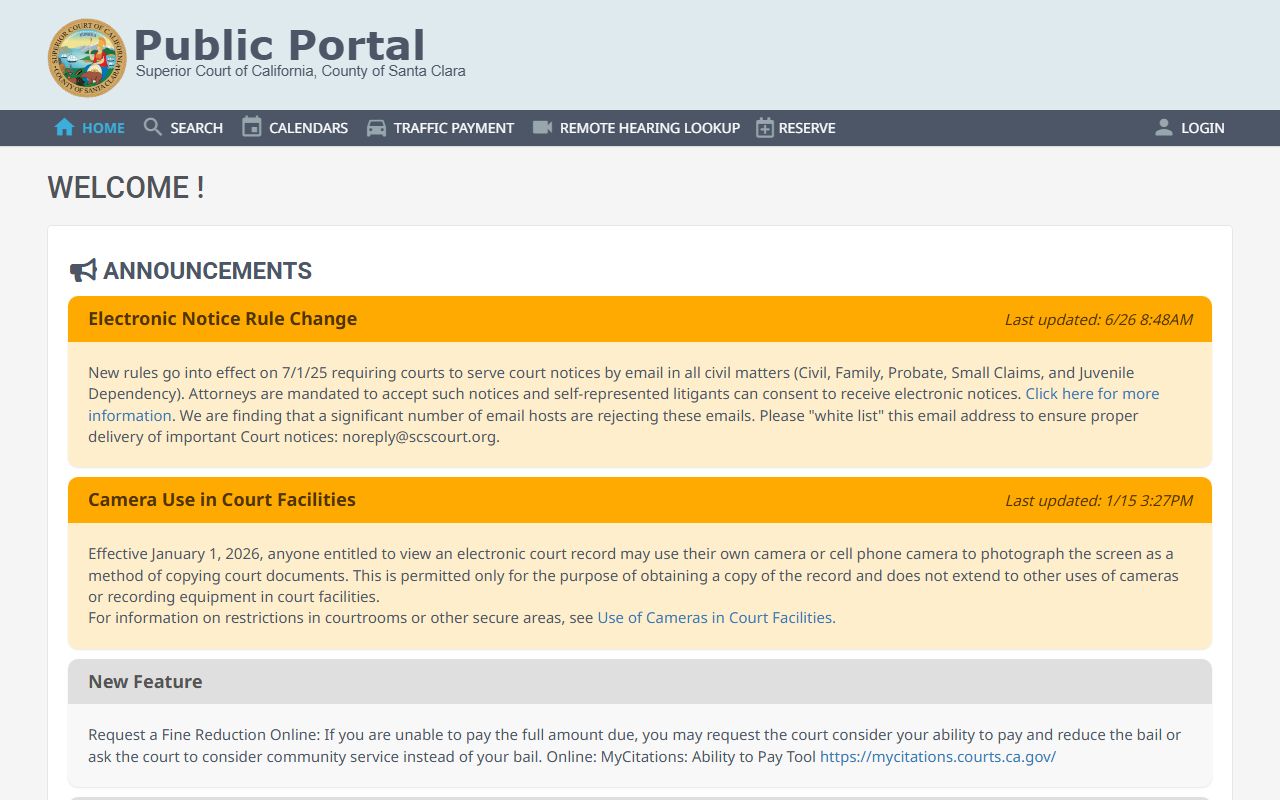
The portal shows the register of actions for each case. The register lists all documents filed, hearings held, and orders issued. You can see when events happened and what actions were taken. For many cases, you can also view and download actual court documents. Document availability varies by case type and filing date.
Searching the portal is free. You don't need an account to look up basic case information. If you want to download documents, fees may apply depending on the case type and access method. The portal updates regularly with new filings and court activities.
Court Locations in Santa Clara County
The main civil courthouse is the Downtown Superior Court at 191 North 1st Street in San Jose, California 95113. You can call them at (408) 882-2100. This location handles most unlimited and limited civil cases filed in the county. The courthouse has multiple departments with judges assigned to different types of cases.
The Family Justice Center is at 201 North 1st Street in San Jose. Their phone number is (408) 792-4200. This location focuses on family law matters including divorce, custody, and domestic violence cases. Some family law records are available through the online portal but access is restricted for privacy reasons.
Both courthouses are open on weekdays during business hours. Security staff check identification at the entrance. Bring a valid photo ID if you plan to visit in person. The clerk's office can help with filing documents and requesting copies of records. Lines can be long during peak hours, especially in the morning.
Getting Copies of Documents
You can obtain copies of civil court documents through several methods. The online portal is the most convenient option. Search for the case and download available documents. Some documents may have fees while others are free to view and download.
For records not available online, visit the courthouse in person. Go to the clerk's office and request the documents you need. Provide the case number or the names of the parties. The clerk will locate the file and make copies for you. Copy fees are $0.50 per page. Bring cash or a check to pay for the copies.
If you need certified copies, ask the clerk for certification. Certification fees are $40.00 for most documents. Certified copies of dissolution judgments cost $15.00. Certification proves the document is a true copy of the original court record. Certified copies are often required for official purposes like appeals or applications.
Research fees apply when you don't have a case number. If the court has to search for records using only party names or other information, they charge $15.00 for research. Having the case number saves you this fee. You can find case numbers through the online portal before you visit the courthouse.
Mail requests are accepted for document copies. Write to the court and include the case number, the documents you want, and your return address. Send a check for the estimated costs. Processing times for mail requests vary based on how busy the court is. Allow several weeks for the court to respond to mail requests.
Civil Case Types
Santa Clara Superior Court handles unlimited civil cases involving amounts over $35,000. These include personal injury claims, medical malpractice suits, business disputes, employment litigation, and real estate conflicts. Unlimited civil cases have complex procedures with extensive discovery. Cases can take years to resolve. Many settle before trial through mediation or negotiation.
Limited civil cases cover disputes between $10,000 and $35,000. Common limited civil matters include contract disputes, property damage claims, landlord-tenant issues, and collection actions. Unlawful detainer eviction cases are limited civil matters. The procedures are simpler than unlimited civil. Discovery is restricted. Cases typically resolve faster than unlimited civil matters.
Small claims court handles disputes up to $10,000 for individuals and $5,000 for businesses. People use small claims for everyday conflicts like unpaid bills, security deposits, minor car accidents, and consumer problems. You don't need a lawyer in small claims. Both sides tell their story to the judge. The judge decides the case right away in most instances. Small claims offers a quick, affordable way to resolve disputes.
Filing Civil Cases
To file a civil case in Santa Clara County, prepare a complaint that states your legal claims. The complaint must identify all parties, describe the facts, and explain what relief you seek. File the complaint with the court clerk at the Downtown Superior Court. Bring the original and copies for all defendants. The clerk checks your paperwork for completeness.
Filing fees follow the statewide California schedule. An unlimited civil complaint costs $435.00. Limited civil complaints for amounts over $10,000 up to $35,000 cost $370.00. Complaints for amounts under $10,000 cost $225.00. Small claims fees are based on the amount you claim. Fee waivers are available if you can't pay. Fill out a fee waiver application and submit it with your case.
After filing, you must serve the defendants. Service means officially delivering a copy of the complaint and summons to each defendant. You can't serve the papers yourself. Hire a process server, ask the sheriff, or have an adult friend do it. The person serving the papers fills out a proof of service form. File the proof of service with the court to show you served the defendants properly.
Electronic filing is available and required for many cases. Attorneys must file electronically in most civil matters. Self-represented parties can choose paper or electronic filing. E-filing systems accept documents 24 hours a day. You register with an approved e-filing provider and pay their service fees plus court filing fees.
New Photography Rights
Starting January 1, 2026, California law allows you to photograph court records when you view them at the courthouse. Assembly Bill 1524 permits members of the public to use cameras or cell phone cameras to photograph electronic court records displayed at public terminals. This provides a way to copy records without paying per-page copy fees.
You can only photograph records you are legally allowed to view. Sealed or confidential records cannot be photographed. Court staff may set reasonable rules about photography to avoid disrupting court operations. Flash photography may be prohibited. You might need to use a particular area for photographing records.
This new right applies when you view electronic records at courthouse computer terminals. It doesn't apply to remote access from home. The law helps people get copies of records more affordably since taking photos is free while printed copies cost $0.50 per page.
Major Cities in Santa Clara County
Santa Clara County includes Silicon Valley and several major cities. All civil cases are filed in Santa Clara Superior Court regardless of the city.
Nearby California Counties
Santa Clara County borders several other Northern California counties. Each maintains separate Superior Court systems.