
Find California Civil Court Records
California civil court records are kept by Superior Courts in each of the state's 58 counties. You can search for civil lawsuits, small claims cases, and unlimited civil actions through county court portals and online databases. Most counties offer remote access to case information through public portals. Some records go back to the 1970s or 1980s, while others start in the early 2000s when courts began digital filing systems.
California Civil Court Quick Facts
Where to Access Civil Court Records
Superior Courts in California handle all civil cases. Each county runs its own Superior Court with jurisdiction over civil disputes filed in that area. The court keeps an official record of every case. This record includes all papers filed, motions submitted, and orders signed by the judge. You can view these records online in most counties or visit the courthouse in person.
Many counties provide remote access to civil case information through online portals. Systems like Odyssey, Tyler Technologies, and custom platforms allow you to search by name or case number from any location. These portals typically show the register of actions, which lists every filing and court event in chronological order. Some portals let you download actual documents for a fee. Los Angeles County uses its own custom portal at the Civil Index. San Diego County offers a Court Index search tool. Orange County provides separate portals for different case types.
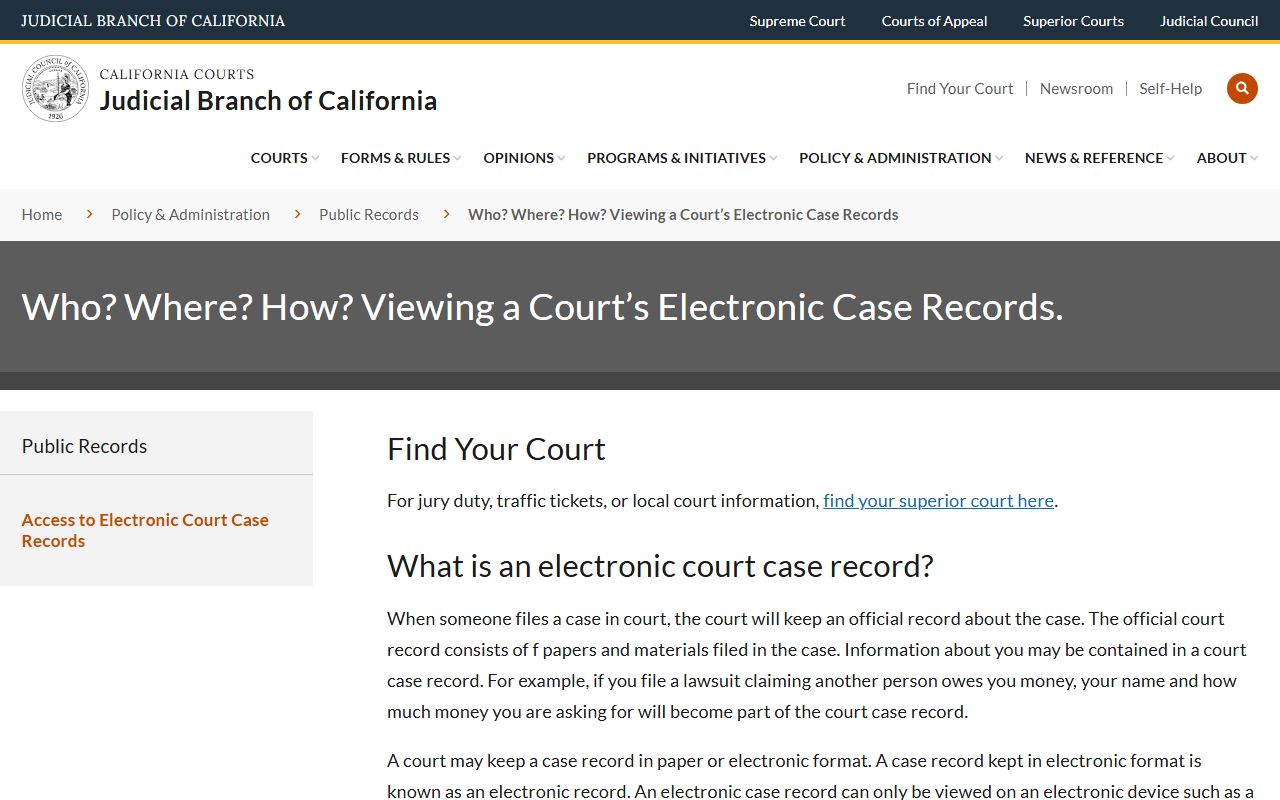
The California Judicial Branch website at courts.ca.gov explains how electronic court records work statewide. It lays out the two ways to access records. First, you can use a computer at the courthouse. Second, you can access records remotely from home or any place with internet. Not every type of case is available online. Family law cases, guardianships, and certain sensitive matters have restricted remote access.
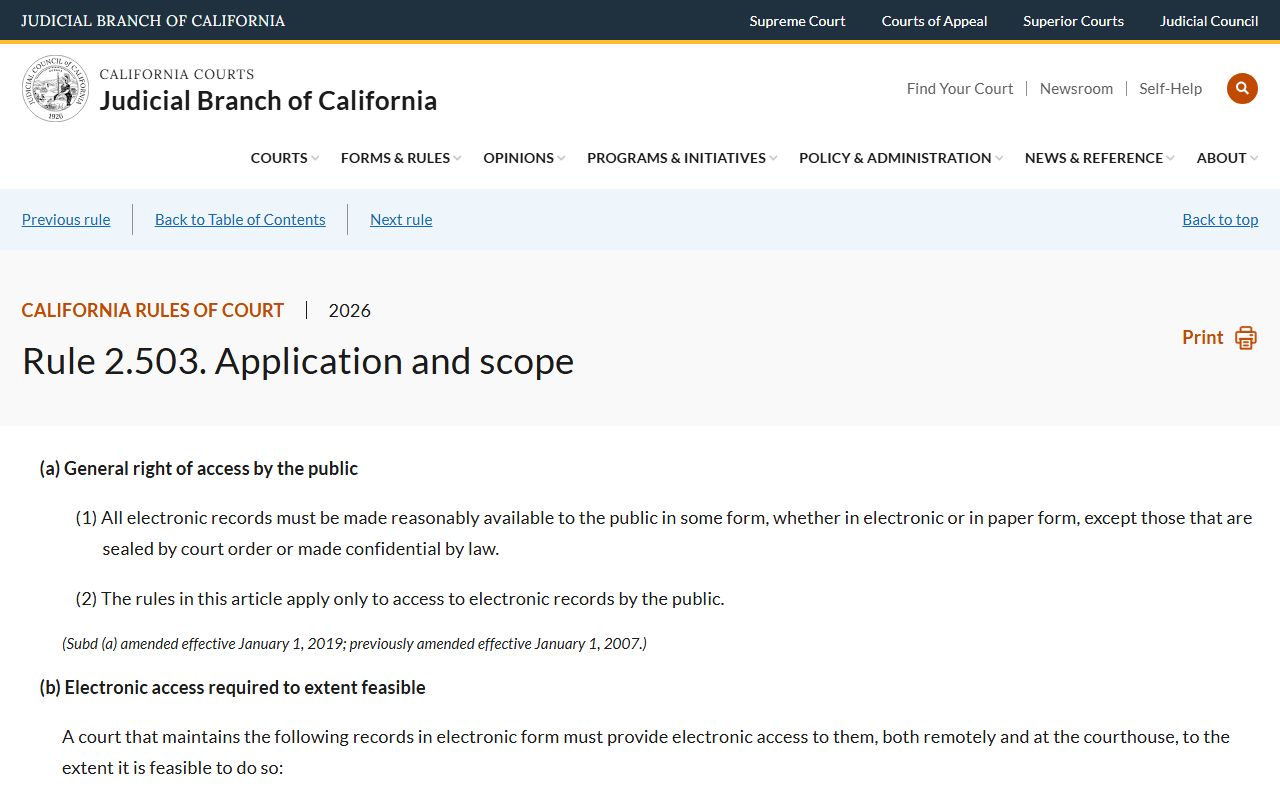
California Rules of Court Rule 2.503 sets the legal framework for public access to electronic court records. You can read the full text at courts.ca.gov. The rule requires courts to provide electronic access to registers of actions, calendars, and indexes in all cases. Courts must also provide access to all documents in civil cases, except for those listed as restricted. The rule applies only to electronic records, not paper files stored at courthouses.
Restricted records include family law proceedings, juvenile cases, guardianships, conservatorships, mental health matters, and criminal proceedings. These can only be viewed at the courthouse itself. Civil harassment cases under Code of Civil Procedure section 527.6 also have courthouse-only access. The same goes for workplace violence prevention cases and gun violence prevention proceedings. Standard civil litigation between businesses or individuals generally has full remote access in most California counties.
How to Search for Civil Cases in California
Search methods vary by county in California. Most counties offer online portals where you can search by party name, case number, or attorney name. A few counties still require in-person visits or written requests for case information. The California Courts website provides a court locator tool at courts.ca.gov to help you find the right Superior Court for your area. Each court's website lists available online services.
When you search online, enter the full name of a party in the case. Some systems search first and last name together. Others let you search just by last name. Use the exact spelling if you know it. Try variations if the first search returns no results. Many portals display a list of matching names with case numbers, filing dates, and case types. Click on a case to see the register of actions and case details. You may need to pay a fee to view or download full documents in some counties.
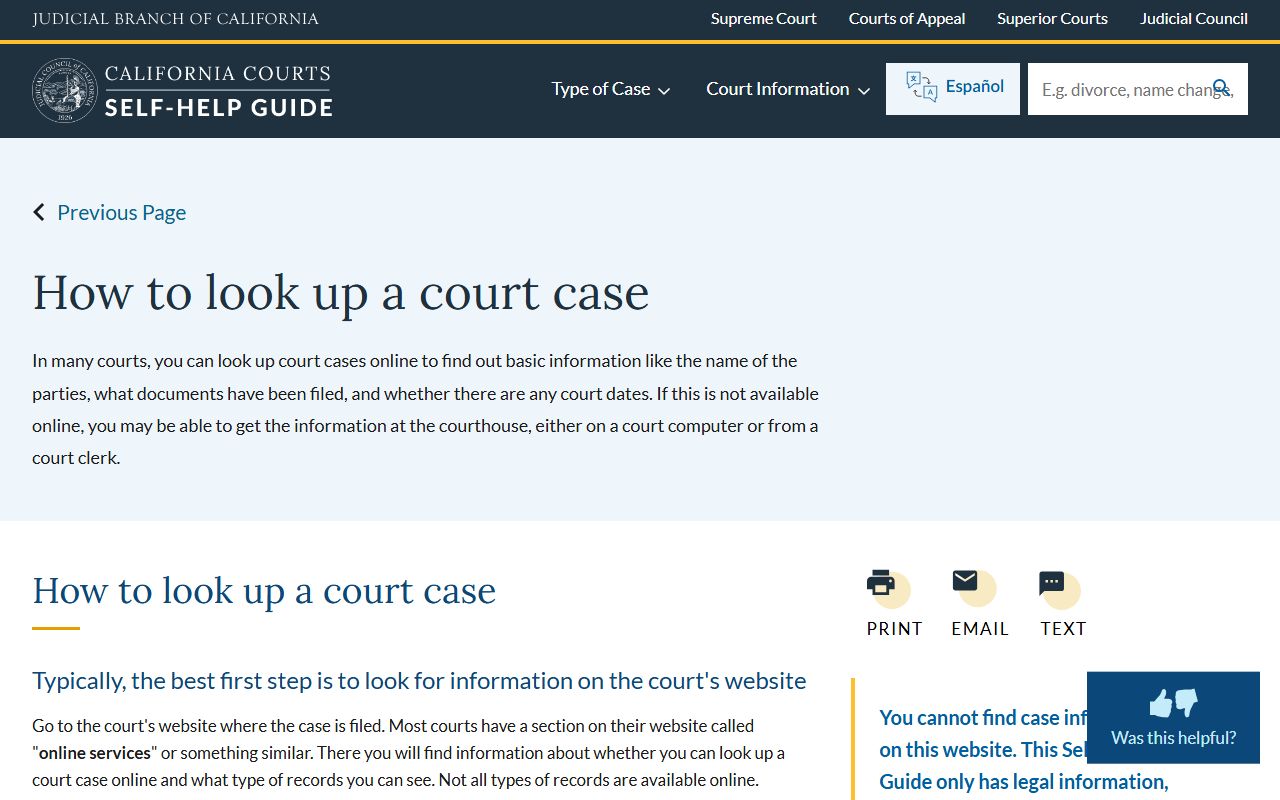
The Self-Help Guide from California Courts at selfhelp.courts.ca.gov provides instructions on looking up case information. The guide explains that county courts keep all records. You cannot find case info on the Self-Help site itself. Most courts have an online services section on their website. Not all types of records are available online due to privacy rules. Limited information appears for divorce and criminal cases.
If a county does not have online access, you can visit the clerk's office in person. Bring photo ID. Tell the clerk the case number or the names of the parties. Staff will pull the file for you to review. You can request copies of documents. Clerks charge a fee per page for copies. Some counties allow you to take photos of records with your phone under Assembly Bill 1524, which took effect January 1, 2026.
Civil Court Filing and Records Fees
Fees for civil cases in California are set by state law with some local variations. The statewide fee schedule is published by the California Courts at courts.ca.gov. Filing fees differ based on the amount in dispute. An unlimited civil case involves claims over $35,000. A limited civil case covers disputes between $10,000 and $35,000. Small claims handle amounts up to $10,000.
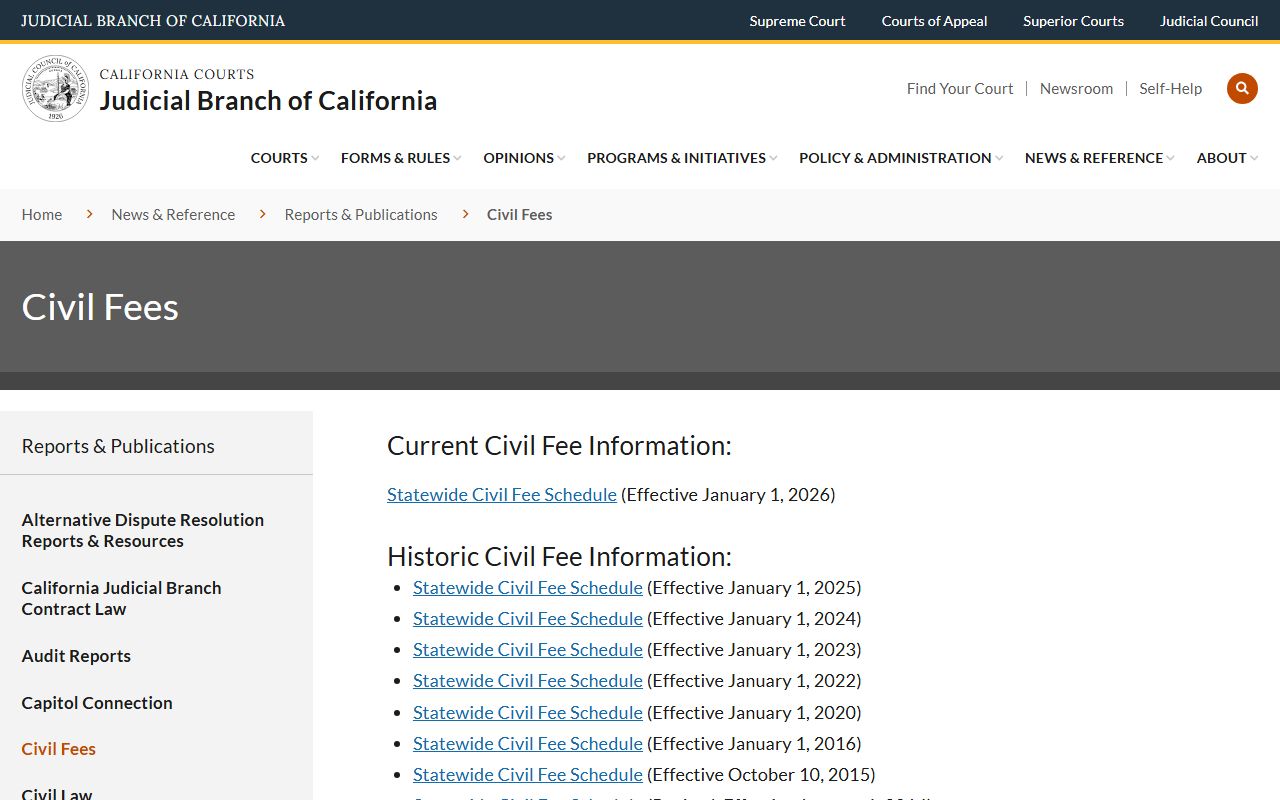
Filing a complaint in an unlimited civil case costs $435 in most counties. The answer or first paper filed by the defendant also costs $435. These fees apply when the amount in controversy exceeds $35,000. For cases seeking more than $10,000 but less than $35,000, the filing fee is $370. Cases under $10,000 cost $225 to file an answer or first paper. Riverside, San Bernardino, and San Francisco counties add local surcharges to these base amounts.
Record copy fees are uniform across the state. Copies cost $0.50 per side of a page. A certified copy of a document costs an additional $40 certification fee. Certified copies of marriage or domestic partnership dissolution judgments cost $15 total. If you request records without a case number, the clerk can charge a $15 research fee for searches over 10 minutes. An exemplification of record, which is a higher level of certification, costs $50.
Some counties charge fees for online access to records. Los Angeles Superior Court charges $4.75 per name search on its Civil Index portal. Document downloads cost $1.00 per page for the first five pages, then $0.40 per page after that, with a $40 maximum per document. Sacramento County eliminated all fees for online searches and document downloads from its public portal. Riverside County sells name search credits ranging from $1.00 for one credit to $250 for unlimited searches during a 30-day period.
Types of Civil Court Cases
California Superior Courts handle several categories of civil cases. Unlimited civil cases involve claims over $35,000. These include breach of contract, personal injury, real estate disputes, business litigation, and construction defects. The case file will contain the complaint, answer, discovery documents, motions, trial transcripts if applicable, and the final judgment or settlement.
Limited civil cases cover disputes between $10,000 and $35,000. Common examples include landlord-tenant disputes, contract disagreements, property damage claims, and collection actions. The procedures in limited civil cases are simpler than unlimited cases. Trials are often shorter. Discovery is more restricted.
Small claims cases handle amounts up to $10,000 for most plaintiffs. Businesses and other entities that file more than 12 small claims cases per year are limited to $5,000 per case. People use small claims court for unpaid debts, minor property damage, security deposit disputes, and other everyday conflicts. Attorneys are not allowed in small claims court. The judge hears both sides and makes a decision the same day in most cases.
Civil records often include these documents:
- Complaint or petition that starts the case
- Summons served on the defendant
- Answer filed by the defendant
- Motions and supporting declarations
- Discovery requests and responses
- Court orders and rulings
- Judgment or final settlement agreement
Unlawful detainer cases, which are eviction lawsuits, fall under the limited civil category. These cases have special access rules. Code of Civil Procedure Section 1161.2 restricts public access to eviction records for the first 60 days after filing. After 60 days, the records become publicly available if the landlord wins at trial. This law aims to prevent eviction records from appearing immediately in tenant screening reports.
Related Record Sources in California
The California Secretary of State maintains business entity records that often relate to civil litigation. You can search for corporations, LLCs, partnerships, and other business entities at bizfileonline.sos.ca.gov. The free database contains over 17 million records. It shows entity names, status, formation dates, registered agents, and officer information. This data helps identify parties in business litigation and verify corporate standing.
The Secretary of State also handles Uniform Commercial Code filings. UCC records document secured transactions and liens on personal property. You can search by debtor name, file number, or secured party name at the UCC division. Searching costs $5.00 per search. Viewing a document image costs $1.00. These records frequently appear as evidence in contract disputes and collection cases heard in civil court.
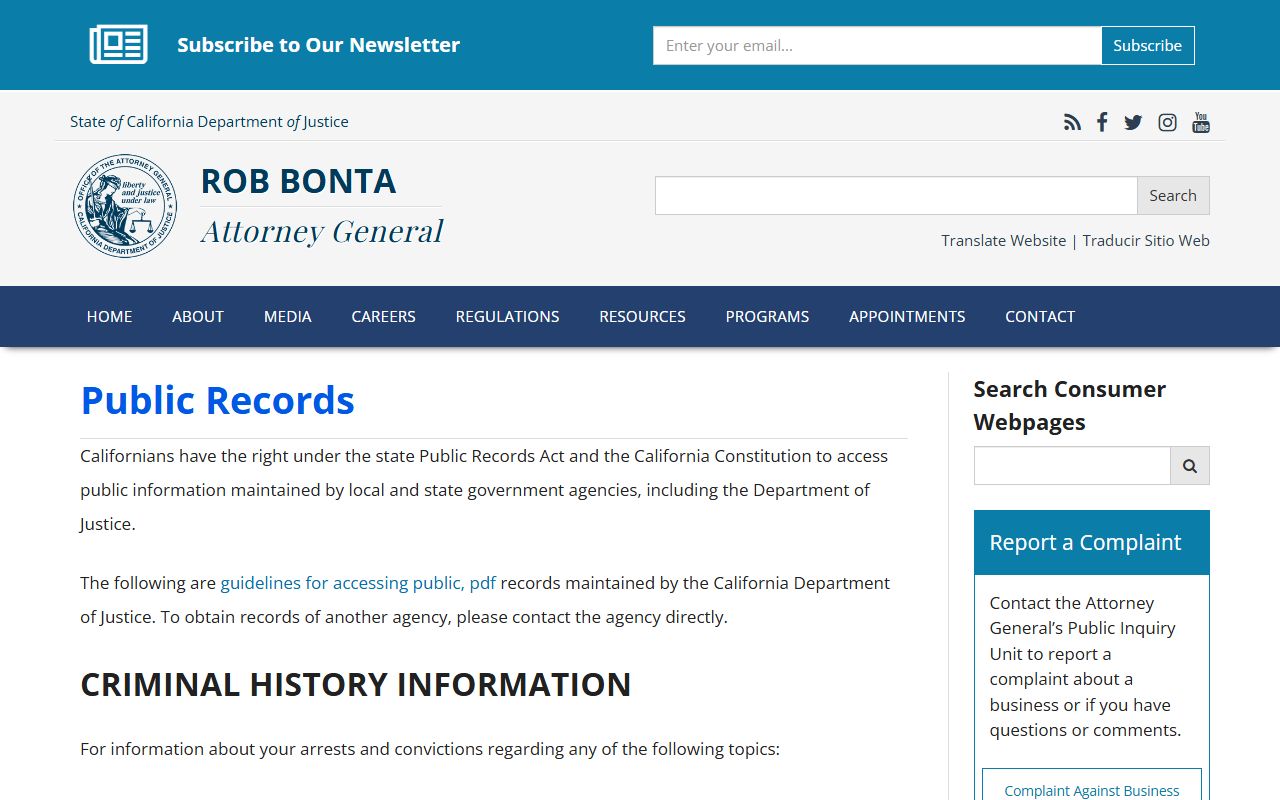
The California Department of Justice maintains some records but does not handle court records. The DOJ's public records page at oag.ca.gov clarifies that the department does not provide certified copies of Superior Court records. If you need court documents, you must contact the court with jurisdiction over the case. The DOJ responds to public records requests within 10 days and may extend that deadline by 14 days if needed.
County Recorders maintain real property records that connect to many civil cases. Deeds, mortgages, liens, and other documents affecting land ownership are recorded at the county level. These records often serve as evidence in quiet title actions, foreclosure cases, and boundary disputes. Each county has its own Recorder or Clerk-Recorder office with separate databases.
California Laws on Court Records Access
Government Code Section 68150 governs trial court records management. The law allows courts to create, maintain, and preserve records in any format including paper, electronic, magnetic, or photographic media. A copy of a court record produced according to this section is deemed an original and may be certified. Unless access is restricted by law, court records must be made reasonably accessible to all members of the public for viewing and copying.
Government Code Section 68151 defines what constitutes a court record. The definition includes all filed papers and documents in the case folder. Some records must be retained permanently according to Judicial Council standards. Other records may be destroyed after a set retention period following proper notice procedures.
The California Public Records Act, found in Government Code Sections 7920.000 through 7931.000, establishes the public's right to access government records. Access to information about the people's business is a fundamental right. A public record is any writing containing information about public business that is prepared, owned, used, or retained by a state or local agency. Agencies must respond to requests within 10 days of receipt.
Government Code Section 68180, added by Assembly Bill 2962, requires courts to provide remote access to public court records about civil cases. This includes registers of actions, calendars, and indexes maintained in electronic format. Courts that provide remote access cannot charge a fee to search for, download, or copy public court records, except for fees authorized by other laws. Some counties have complied by removing access fees, while others continue charging under different legal provisions.
California Rules of Court Rule 2.503 implements these statutory requirements. The rule requires courthouse electronic access and remote access to registers of actions, calendars, and indexes in all cases. Remote access to full records is required for civil cases except for family law, juvenile, guardianship, conservatorship, mental health, criminal, and certain protective order cases. Those restricted case types only allow remote access to the register, calendar, and index.
How Long It Takes to Get Records
Online searches return results instantly in most counties. You type in a name or case number and the system displays matching cases immediately. Downloading documents from an online portal usually takes just a few minutes once you pay the fee. Some counties process the payment and make the file available right away. Others may take a few hours to prepare the document for download.
In-person requests at a courthouse vary by workload and file location. If the file is on-site and the clerk is not busy, you may get copies within an hour. If the file is stored off-site at an archive facility, expect delays. Sacramento County warns that physical civil files from before November 13, 2007 are kept off-site and take about 10 business days to retrieve. San Francisco County charges a $6 fee and requires at least 15 business days for off-site file retrieval.
Written requests sent by mail take the longest. Sacramento Superior Court states that written requests to the Records Unit take about 4 to 6 weeks to complete. That time includes copying, certifying, and researching fees. If you need records quickly, online access or an in-person visit works better than mailing a request.
Note: Large document requests or complex research needs may take longer regardless of the method you use.
Court Technology Systems
About 28 of California's 58 Superior Courts use Tyler Technologies Odyssey as their case management system. Odyssey serves roughly 70 percent of the state's population. Counties using Odyssey include Los Angeles, Orange, San Diego, San Bernardino, Alameda, Santa Clara, Sacramento, Fresno, Kern, and many others. The Odyssey portal interface looks similar across counties, making it easier to use if you search records in multiple jurisdictions.
Journal Technologies provides case management systems for Los Angeles, Sacramento, and San Francisco counties. Los Angeles County uses a custom portal at the Civil Index website. Sacramento uses the Journal Technologies public portal for cases filed after November 13, 2007. San Francisco has limited online access through a basic case query tool.
A newer system called re:SearchCA operates in some counties. This multi-jurisdictional platform started in San Luis Obispo County and expanded to Mendocino County. The system offers free basic searches. You can download documents for $0.50 per page. Re:SearchCA allows searching across multiple counties from one interface, which is unusual in California where most systems are county-specific.
San Joaquin County uses a system called FullCourt. Other counties run custom or legacy systems developed locally. Smaller rural counties may have limited or no online access. Alpine, Sierra, and Trinity counties do not offer public online portals. You must visit or call those courthouses to get civil case information.
Browse Civil Records by California County
Each of California's 58 counties operates its own Superior Court. Select a county below to find contact information, online portals, and local filing procedures for civil cases.
Civil Records in Major California Cities
California's larger cities are served by their county Superior Courts. Find information about civil court records in major metropolitan areas below.